.jpg)
In my last post, we talked about figuring out your mission and narrowing down the types of airplanes that fit your budget and flying goals. Now comes the fun part: shopping for airplanes.
Before you dive into the listings, it helps to understand what you're actually looking at. Aircraft listings are full of acronyms, maintenance terminology, and specs that can seem overwhelming at first, but once you know what they mean, you'll be able to quickly separate the good candidates from the ones that may need a closer look.
Where to find airplanes for sale
Take a look online
Pages like Trade-A-Plane, Controller, and Barnstormer are great places to start. Facebook has multiple Aviation Buy, Sell, and Trade groups that are worth joining. If you found a type through a test drive, check out type-specific forums like Mooneyspace, Beechtalk, and Cessna 150/152 Club.
Try your local airport
The billboards in the pilot's lounge often have listings posted, or for a riskier approach, take a closer look at the ramp. If a plane hasn’t moved from the tie-down, it never hurts to find the owner and ask for more information.
What to look for in a listing
There are always aircraft-model-specific things to look for, but at a high level, here’s what to keep an eye out for.
Time on the Airframe
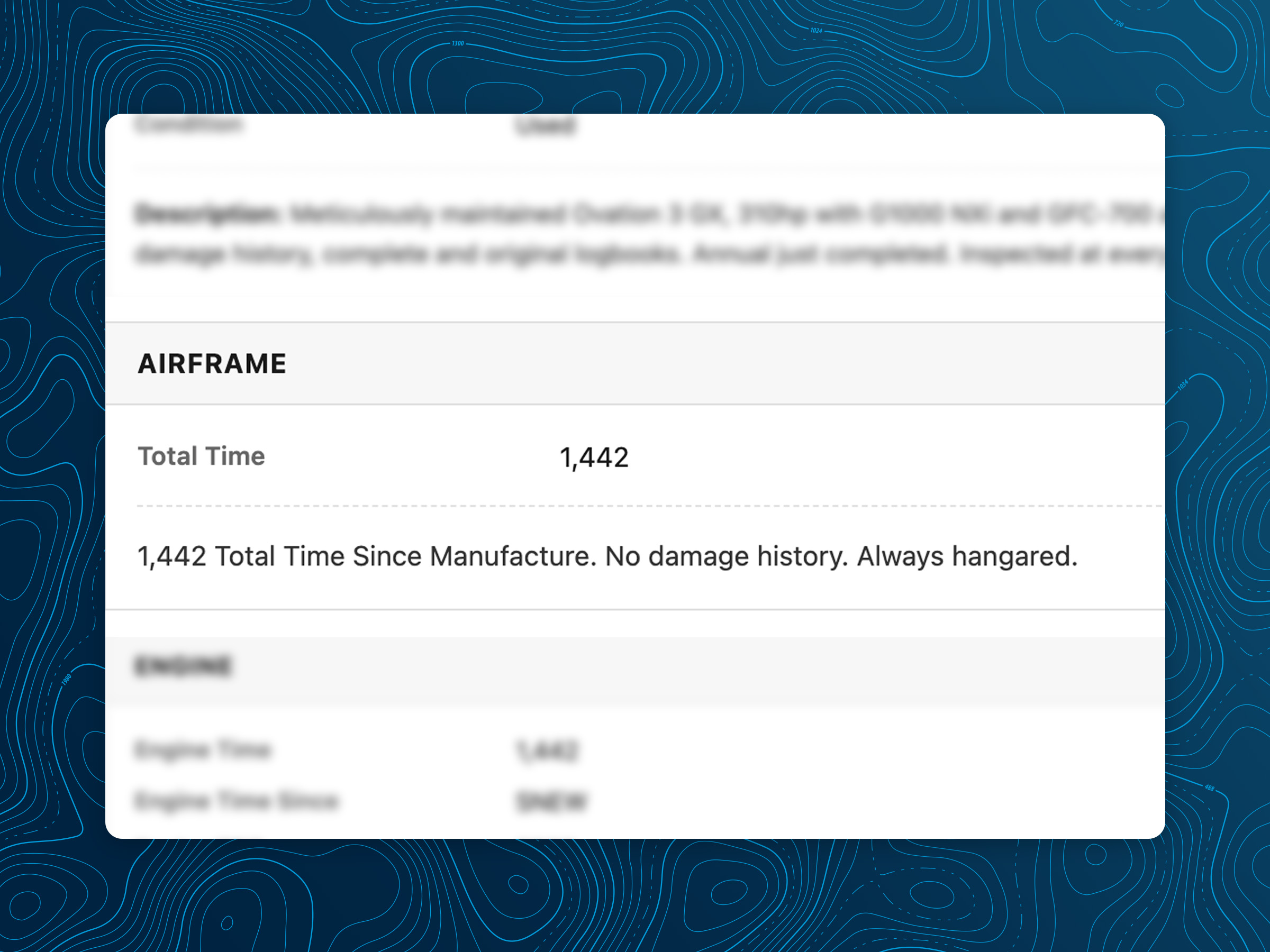
Often denoted as AFTT, this number should always be viewed in the context of the aircraft's age.
The more something is used, the more it wears out, and the same is true for an airframe. That said, a well-maintained aircraft can accumulate a lot of hours and still be a great airplane. For example, a 2000 model with 8,000 hours was likely used heavily, perhaps as a trainer, while a 1965 model with 5,000 hours is fairly typical.
Very low AFTT on an older airplane often means it spent long periods sitting. That's not necessarily a bad thing, and you can find some excellent aircraft this way. However, you'll want to confirm that appropriate maintenance was still performed, since many components are life-limited, not just time-limited.
As a general rule of thumb:
- Under 7000 hrs AFTT is usually good
- Over 7,000 hrs and I start getting the heebie-jeebies
- Over 10,000 hrs is a no for me, but that may not be the case for you
Time on the engine
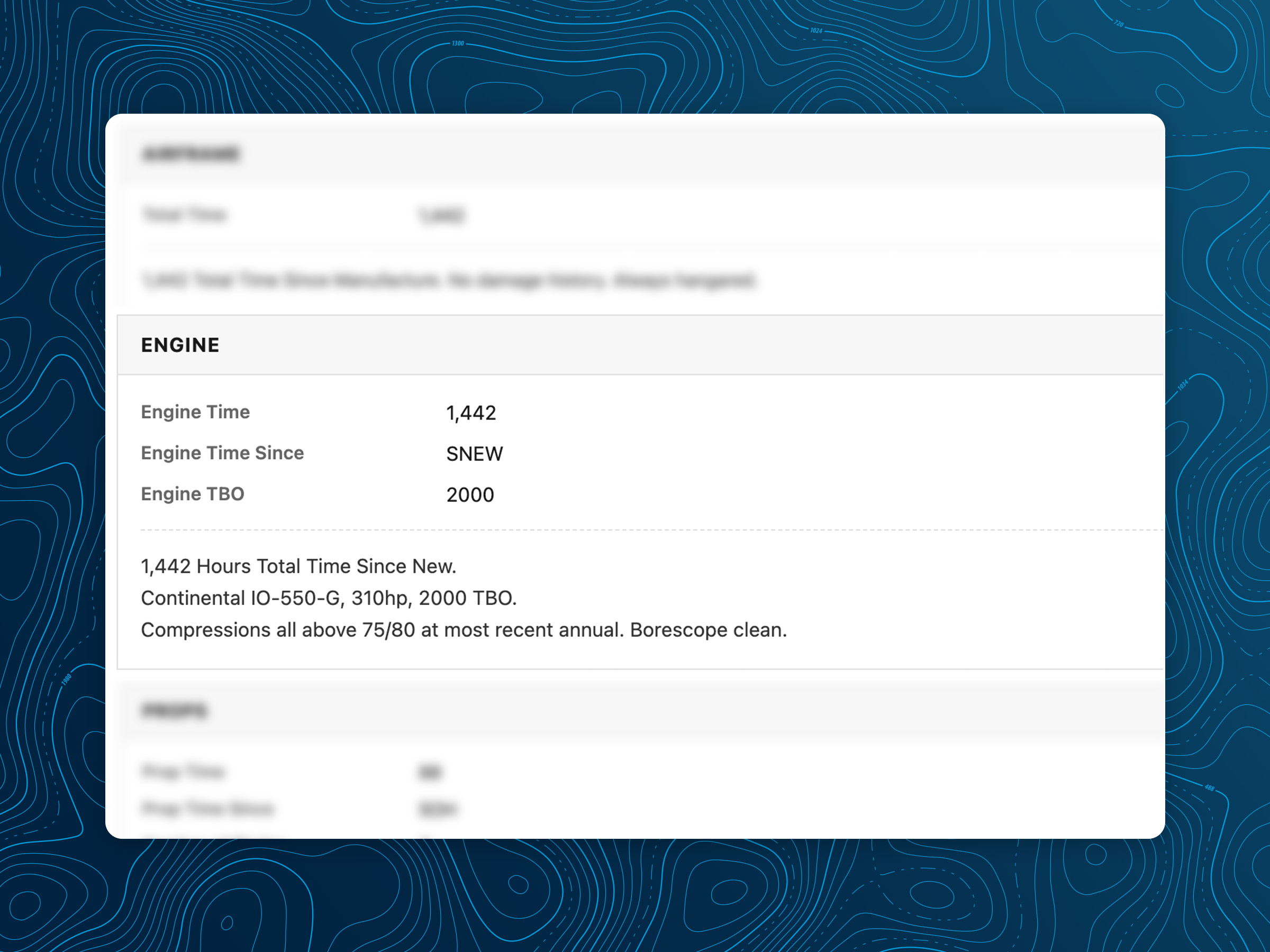
Compare this against the engine's TBO (Time Between Overhaul).
The engine is one of the most expensive components on the airplane, typically costing $25,000 to $55,000 to overhaul or replace, depending on the type. Because of that, it's worth paying close attention to both the engine time and how that time is reported.
Some common acronyms you'll see include:
- SMOH (Since Major Overhaul): The engine was inspected and any out-of-tolerance components were repaired or replaced to bring them back within limits. This could include cylinders, magnetos, starters, and other components. Each engine manufacturer defines what constitutes a major overhaul, and the scope can vary from one shop to another.
- SNEW (Since New): The engine was replaced with a factory-new engine rather than overhauled.
- SFRM (Since Factory Remanufacture): The engine was remanufactured by the factory. The manufacturer is the only entity that can legally "zero-time" an engine and assign it a new serial number
- STOH (Since Top Overhaul): The cylinders were replaced or overhauled, but the bottom end of the engine (crankcase, crankshaft, camshaft, etc.) was not. On larger engines, such as six-cylinder Continentals, this is fairly common because cylinders often wear out before the bottom end requires overhaul.
That said, if the bottom end has 2,000 hours on it and only the cylinders were replaced, I start asking questions. It can be a sign that the owner was looking for a less expensive alternative to a full overhaul.
What I Look For in an Engine
When evaluating engine time, I generally think about it in a few buckets:
- Low-time engine: 0-200 hours
- Mid-time engine: Roughly halfway to TBO (for example, 900-1,100 hours on a 2,000-hour TBO engine)
- High-time engine: Approaching or exceeding TBO
One thing many buyers overlook is that the age of the overhaul matters just as much as the hours. Airplanes like to fly. An engine with 500 hours since overhaul may sound attractive, but if that overhaul was completed 30 years ago, I'd be cautious. Long periods of inactivity allow moisture to collect inside the engine, which can lead to internal corrosion.
For me, the sweet spot is often an engine with 500-800 hours since overhaul that's 5-10 years old. It's accumulated enough time to work out any post-overhaul issues while still having plenty of useful life remaining.
It's also important to remember that TBO is a guideline, not a hard limit. Some engines won't make it to TBO, while others can safely exceed it with proper maintenance and regular use. In fact, Lycoming notes that engines flown regularly may be able to exceed published TBO recommendations.
If you're considering a high-time engine, go into the purchase assuming an overhaul could be needed at any point. On the other hand, if the airplane is flown regularly and priced appropriately, a high-time engine isn't necessarily a dealbreaker.
There's also an argument for buying an airplane that's closer to overhaul. If the price reflects the engine time, you'll have the opportunity to choose the overhaul shop yourself and know exactly what's inside your engine when the work is complete.
Finally, not all overhaul shops are created equal. Certain names carry strong reputations in the industry, and sellers will often highlight them in a listing. If you see a well-known shop called out specifically, that reputation may be part of the airplane's value proposition.
Avionics
Think back to your mission. If you're mostly flying locally and not doing much IFR, do you really need a full glass cockpit? The latest WAAS GPS? An autopilot? We have ForeFlight, after all.
That said, avionics upgrades are expensive. Depending on the equipment and installation, it's not unusual to spend $30,000-$60,000 or more. Buying a better-equipped airplane upfront can save a lot of money and downtime later.
My take:
- ADS-B Out: Must-have.
- WAAS GPS: A big plus. If you're planning to fly IFR regularly, I'd consider it mandatory.
- Engine monitor: Strongly preferred.
- Autopilot: Nice to have, especially if you're planning longer trips or IFR flying.
- Recent avionics work: A major plus.
One thing to keep in mind is that avionics age matters just as much as the equipment list itself.
For example, if a listing advertises a GPS but it's an Apollo MX-20 that's no longer supported and pushing antique status, I don't really count that as having a GPS.
Likewise, if the airplane has a Garmin 430W, has it been IRANed by Garmin recently? They're still excellent units, but most are now more than 20 years old, and many benefit from maintenance and refurbishment.
Time on the Propeller
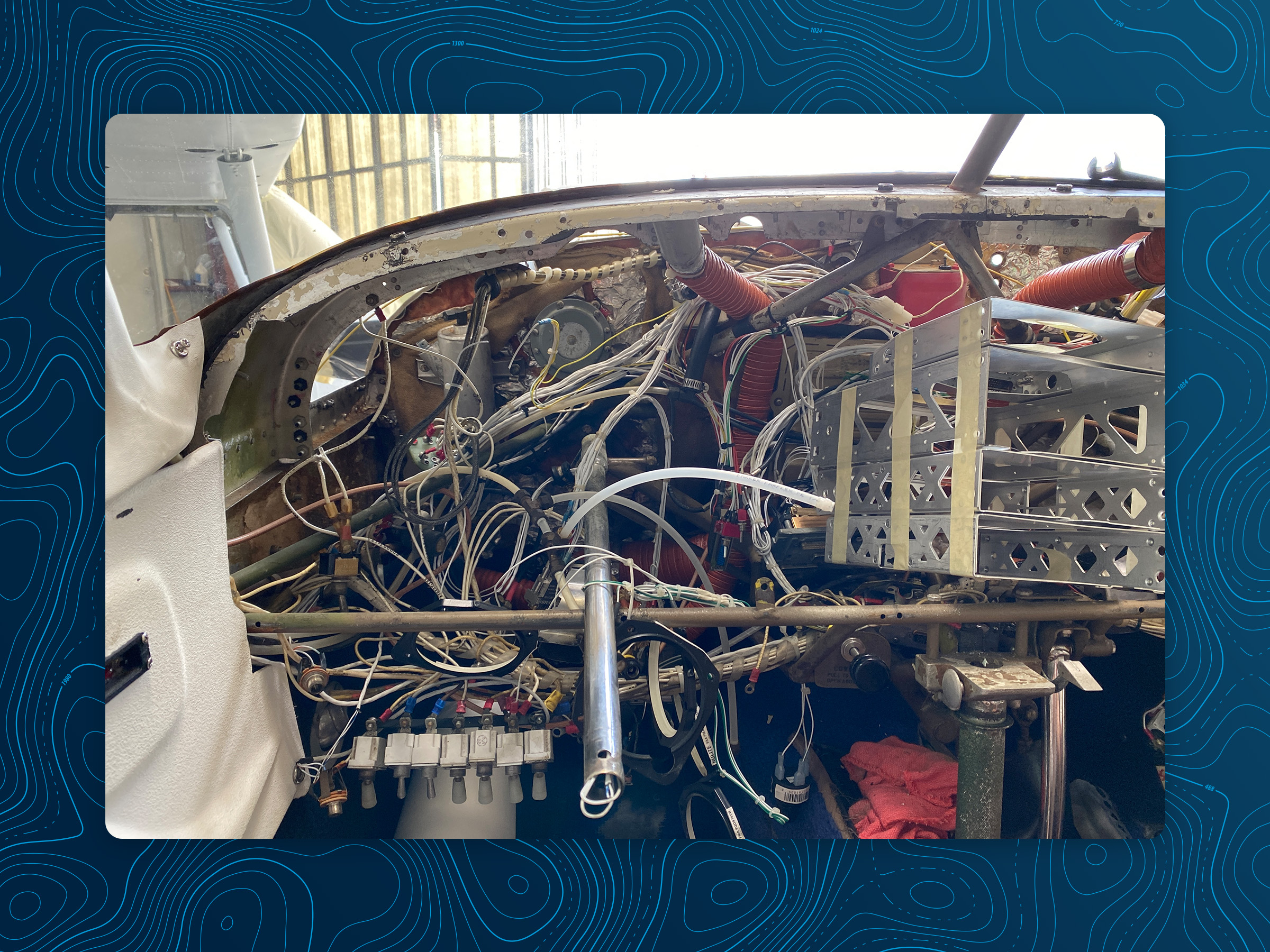
You'll typically see this listed as SPOH (Since Prop Overhaul).
To me, propeller time isn't nearly as important as engine time. Prop shops may disagree, but they also make their living overhauling and selling propellers.
Like engines, propellers have recommended overhaul intervals based on both time and hours. As long as the prop time is reasonably close to the engine time and the last overhaul wasn't more than 20 years ago, I don't spend too much time worrying about it.
Location
Where an airplane has spent its life matters more than most people realize.
If it's based in Florida or another highly corrosive environment, look for evidence that corrosion prevention was taken seriously. Was CorrosionX or a similar treatment applied regularly? Has the airplane always lived there, or was it only relocated recently?
Storage matters too. A hangared airplane generally ages more gracefully than one left outside on the ramp. Sun, rain, humidity, and temperature swings all take their toll over time.
Upgrades
Many upgrades are aircraft-specific, but a few generally catch my attention:
- LED lighting: Longer lasting and easier on the electrical system.
- Speed mods: Depending on the aircraft, these can provide meaningful performance improvements.
- GAMI injectors: A plus for fuel-injected airplanes, helping improve fuel distribution between cylinders.
- Engine preheat systems: Particularly valuable if you live in a cold-weather climate.
Last Annual
Annuals are due, well, annually.
If the last annual was June 2025 and you’re looking at it in June 2026, you’d have to turn around and do an annual on it. Plus, why do they want to sell right before the annual is due?
A recent annual is not always a good thing either. A seller may have paper-whipped a bunch of things in the name of a fresh annual to try to make it more appealing to a buyer. Annuals can go either way, the logs and prebuy inspection will tell the real story.
Paint, Glass, and Interior Condition
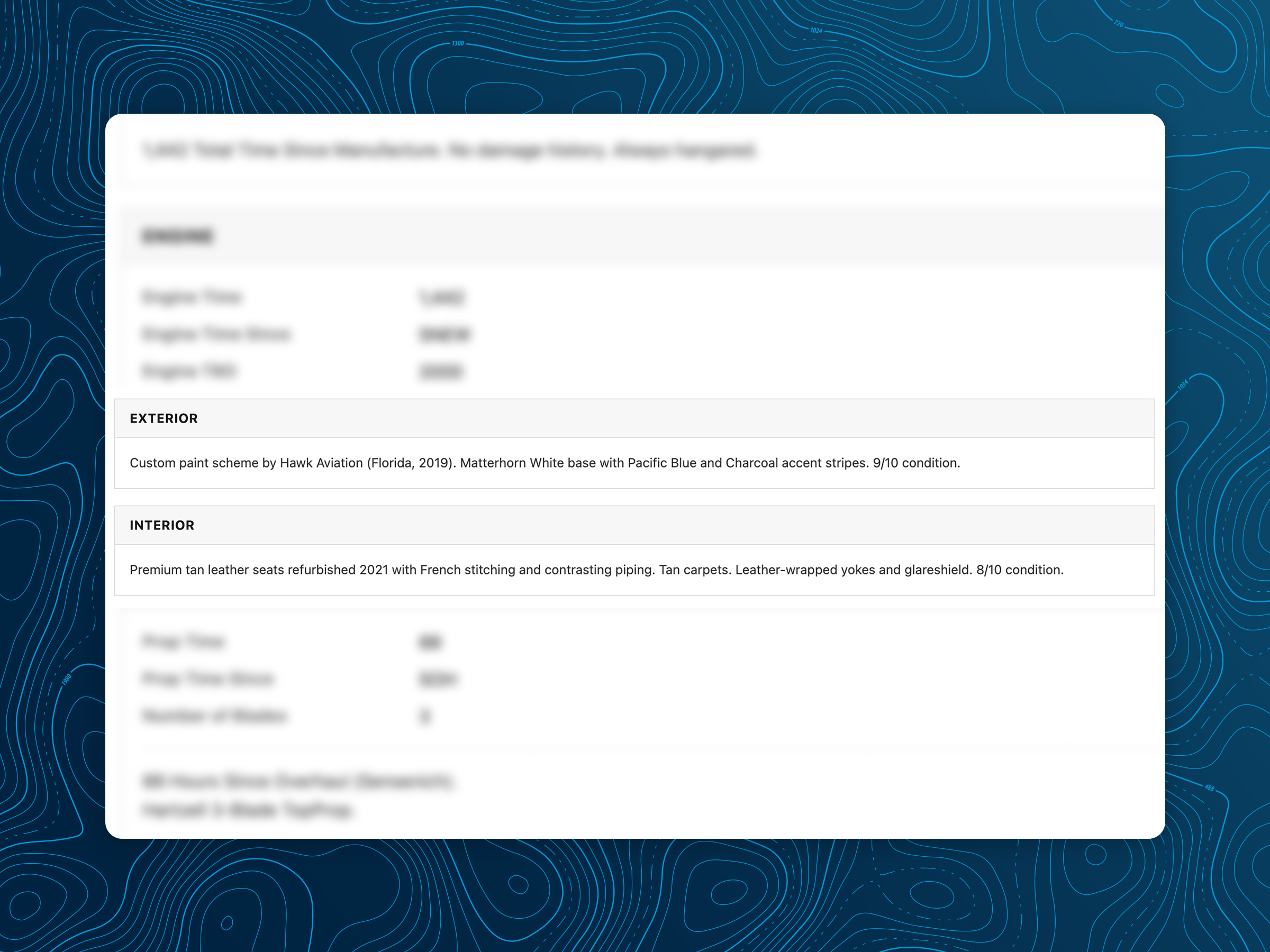
You'll often see paint, glass, and interior condition rated on a scale from 1 to 10, with 10 typically representing like-new condition.
Paint
Paint is more than cosmetic. Repainting an airplane can cost anywhere from $18,000 to $30,000 or more, depending on the aircraft and shop.
Location matters here as well. In humid, coastal environments, exposed metal can become a corrosion concern. In drier climates like Arizona, a small amount of bare metal is usually less concerning.
Glass
Take note of cracks, crazing, hazing, or discoloration. Replacing windows and windshields can become surprisingly expensive.
Interior
The interior is almost purely aesthetic. The plane could have the world’s worst interior, and it’s not going to hurt the plane. However, the vast majority of your time with the plane will be IN the plane, so naturally, you want it to be comfortable!
There are a variety of ways to clean up the interior, and they range in cost from less than $5k all the way up to $20k.
Reading listings gets easier the more you do it. After a while, you'll start scanning for AFTT before you even look at the photos. But understanding a listing is just the first step to owning your own airplane. Once something catches your eye, it gets exciting, you get to go see it in person!
In my next blog post, we'll take a closer look at the financial side of the airplane buying process, including financing options, insurance requirements, taxes, and other costs to consider before closing the deal.